





OpenAI's model for generating claymation-style portraits offers a useful case study in style-specialised AI. Instead of a general-purpose tool, this model is tuned for a specific aesthetic output. This article examines the technical methods behind this effect, explores its limitations and considers how you can apply similar principles in custom software.
How style-specialised models work
Training for a specific aesthetic
The claymation effect is not an inherent capability of a base model but the result of targeted fine-tuning. The process involves training a foundational model on a curated dataset of thousands of images that exemplify the desired style—in this case, clay figures, stop-motion film stills and related textures. This specialisation increases proficiency in one style but reduces the model's ability to generate outputs outside that domain. The trade-off is clear: the model becomes an expert in a narrow field at the cost of being a generalist.
Controlling generation with prompts
Claims of 'full artistic control' are an overstatement. Control in generative models is probabilistic and iterative. You guide the output through detailed text prompts, negative prompts to exclude unwanted elements, and numerical parameters that adjust adherence to the prompt. Achieving a specific composition or expression often requires multiple attempts and a technical understanding of how these inputs influence the diffusion process. It is a skill, not a simple command.
Deployment and performance considerations
The computational cost of image generation is significant. For a public-facing application, you must balance image quality with latency and cost. A high-resolution image from a complex model may take several seconds or more to generate, requiring powerful and expensive GPU resources. This can be too slow or costly for real-time use cases. The technical challenge is to optimise the model and infrastructure to meet performance targets for your specific application.
Implementing content guardrails
Public-facing generative tools require robust safety systems. These are not simple on/off switches but layered technical solutions, including prompt filtering, denial of unsafe concept generation and classifiers that review outputs before they are shown to the user. The primary challenge is that these systems are imperfect. They can be overzealous, blocking legitimate requests (false positives), or they can be bypassed by adversarial prompts, creating a continuous engineering problem of refinement and adaptation.
"A generative model specialised for one style gains proficiency at the cost of flexibility. The engineering challenge is defining a use case narrow enough for the model to master."
Applications for style-specialised models
Beyond novelty, style-tuned models have practical applications. The core principle is generating a high volume of visual content that adheres to a consistent, predefined aesthetic. This is useful for any organisation that relies on a strong brand identity.
For an e-commerce business, a model could be trained on your product catalogue and brand guidelines to generate an endless supply of lifestyle images or marketing assets. For an education platform, a model could produce illustrations for course materials in a uniform style, from historical figures to scientific diagrams. The key is moving beyond generic API calls to a model fine-tuned on your proprietary data and for your specific purpose.
Building a custom generative AI system
We develop custom AI systems for web, mobile and internal use. This includes building applications that incorporate generative AI. Our process involves more than just integrating a third-party API. We help you navigate the decision between using a pre-built model, fine-tuning an open-source model like Stable Diffusion on your own data, or developing a new architecture where necessary.
We work with you to define the technical requirements, curate and prepare training data, and build the user interface and application logic around the AI core. Our teams handle the complete software development lifecycle, from UI/UX design to the cloud and DevOps engineering required to deploy and scale the system.
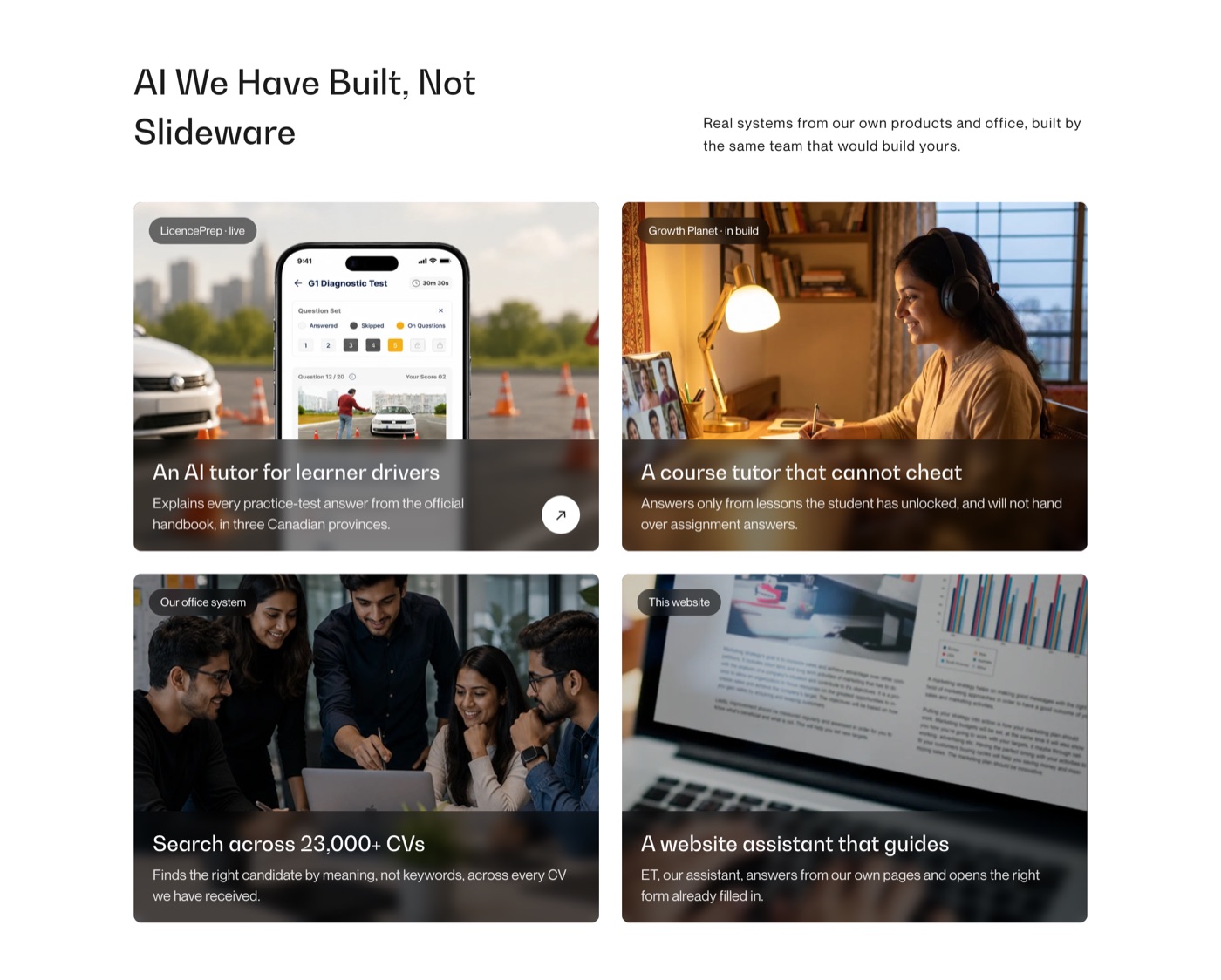
We have built this
AI we have built and run
Our office system searches more than 23,000 CVs by meaning, not keywords. LicencePrep’s tutor explains every answer from the official handbook. Growth Planet’s tutor answers only from the lessons a student has unlocked.
Want this for your business?
Ask ET on our website, or book a free 30-minute call with a project lead, not a salesperson.

