





Location-based services (LBS) allow your mobile application to use geographical data. Integrating them is not a single technical decision but a series of trade-offs between precision, battery consumption and user privacy. A food delivery app needs a different approach to a city guide, and both differ from an asset tracker.
This article covers the core location technologies, the architectural challenges you will face and how to apply LBS to solve specific business problems. We will focus on the practical choices you need to make when building these features for iOS and Android.
Choosing the right location technology
No single technology is best for all use cases. Your choice depends entirely on whether you need high precision, low power consumption or indoor functionality.
GPS (Global Positioning System)
GPS offers high accuracy, typically within a few metres, by communicating with satellites. It is the standard for turn-by-turn navigation and tracking outdoor activities like running or cycling. Its primary drawback is high battery consumption. It also performs poorly indoors and in dense urban areas where signals are obstructed.
Wi-Fi positioning
This method determines location based on the user's proximity to known Wi-Fi networks. It is less accurate than GPS but consumes significantly less power and works reliably indoors. It is suitable for apps that need city-level or neighbourhood-level context without requiring constant, precise tracking.
Cellular network triangulation
Using the location of nearby mobile phone towers, this method provides a coarse location with minimal battery impact. Accuracy can vary from a few hundred metres in cities to several kilometres in rural areas. It is best for passive location awareness, such as adjusting content based on a user's country or region, without actively tracking them.
Beacons and geofencing
These are for micro-location and triggered events. Geofencing creates a virtual perimeter around a real-world area, using GPS, Wi-Fi or cellular data to trigger an action when a user enters or leaves. Beacons are small Bluetooth Low Energy (BLE) devices that broadcast a signal, allowing for precise indoor navigation or proximity-based notifications within a few metres.
Architectural challenges and how to solve them
Integrating LBS effectively requires more than just calling a location API. You need to plan for resource management, data privacy and signal unreliability.
Managing battery consumption
Constant GPS polling will drain a user's battery. To prevent this, you can use the fused location provider on Android or set appropriate accuracy and distance filters on iOS. This allows the operating system to batch location updates and use the most power-efficient method available. You should also reduce update frequency when your app is in the background.
Handling data privacy and user consent
Do not ask for location permission the first time your app launches. Instead, request it contextually when a user attempts to use a feature that requires it, and explain why the permission is needed. If possible, offer a degraded version of the feature that works without location. When you store or transmit location data, anonymise it to protect user privacy.
Dealing with inaccuracy and failure
Location signals can be weak, intermittent or inaccurate. Your app should be built to handle this. You can display an accuracy radius to the user to indicate uncertainty. Cache the last known good location so the app can function during temporary signal loss. When processing location data, such as for a fitness tracker, you need to filter out anomalous readings caused by signal jitter.
Applying location services to business problems
LBS can solve distinct operational challenges when the right technology is applied thoughtfully.
Logistics and fleet management
For services like food delivery or agri-commerce, tracking vehicles in real time is a core requirement. We have built systems for clients like Foodalios and Univia that provide live tracking for dispatchers and customers. The technical challenge is to provide frequent updates without draining the driver's device battery. This is solved by dynamically adjusting the location polling interval based on the delivery's status.
Proximity engagement and indoor navigation
Retailers and event organisers can use LBS to interact with users at a specific location. A geofence can trigger a push notification with a welcome message or special offer when a user arrives. Inside a large venue, BLE beacons can provide turn-by-turn directions to a specific booth or product, solving a problem GPS cannot.
Itinerary planning and discovery
Travel and community apps, such as for NAR India or Indians in Germany, use location to help users find nearby points of interest or events. A key consideration here is data connectivity, which can be expensive or unavailable when travelling. A well-designed app will allow users to pre-download maps and location data for an area to ensure it remains functional offline.
Fitness and activity monitoring
Fitness apps use GPS to track routes, distance and speed. The main technical task is to convert raw, often noisy, GPS data into a clean and accurate representation of the user's activity. This involves algorithms to smooth the path, remove outlier points from signal drift and calculate metrics like pace and elevation gain.
Conclusion
Location-based services are a component of many modern mobile apps, but they are not a simple feature to add. A successful implementation requires a clear understanding of your application's needs. By making deliberate architectural choices about the trade-offs between accuracy, battery life and user privacy, you can build features that are both useful and responsible.
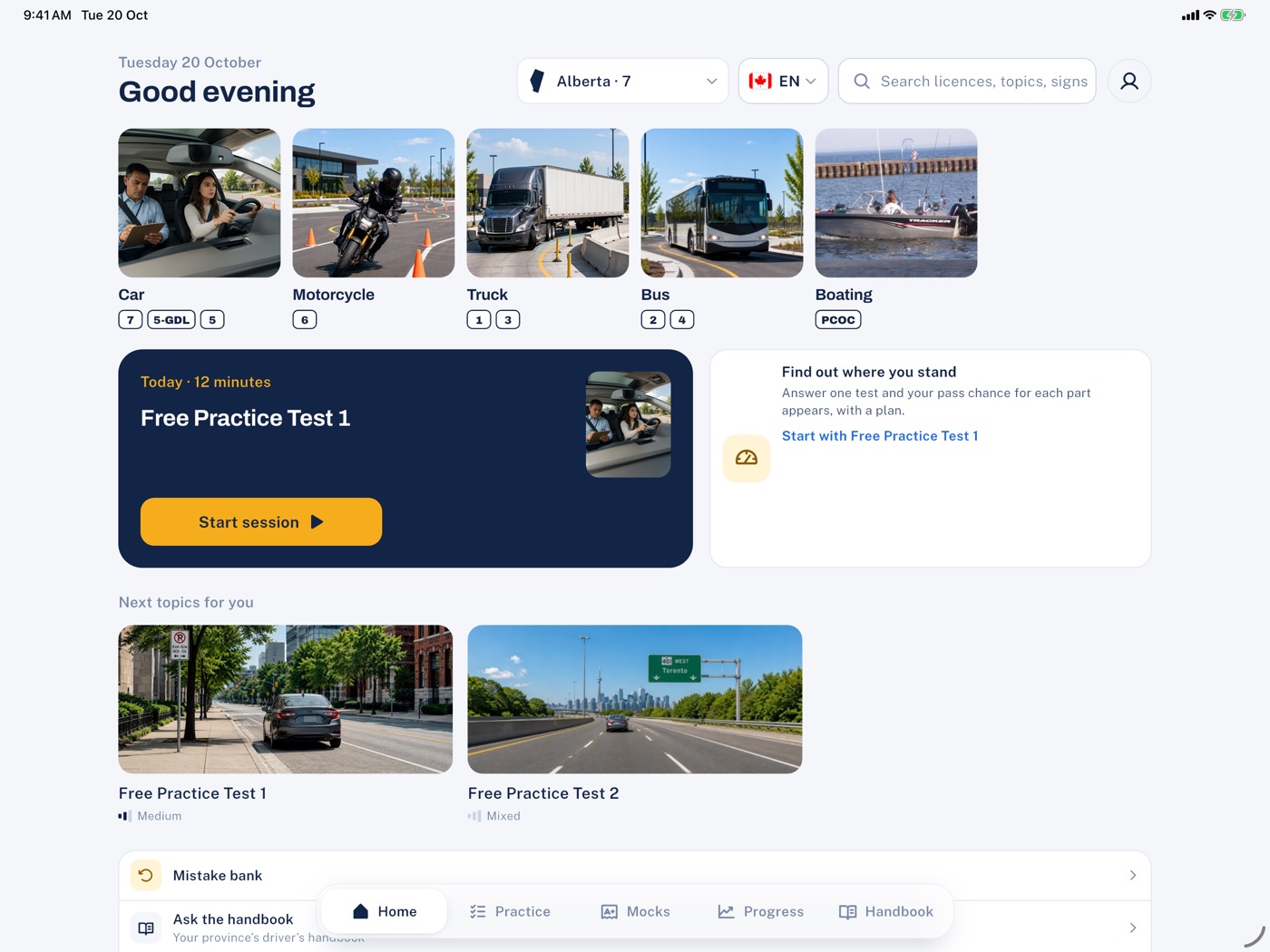
We have built this
LicencePrep and Growth Planet, our own Flutter apps
LicencePrep, our driving-test practice app for Ontario, Alberta and British Columbia, runs on iPhone, iPad and Android from one Flutter codebase. Growth Planet ships its iPhone and Android apps the same way.
Want this for your business?
Ask ET on our website, or book a free 30-minute call with a project lead, not a salesperson.

