





Creating a believable AI-driven talking character involves more than connecting a text-to-speech engine to a 3D model. It requires orchestrating multiple specialised systems where performance, quality and cost must be carefully balanced. A system like Meta Mocha is not a single product but an architecture, a collection of components that work together to generate voice, expression and interaction.
Building such a system is a custom software development challenge. Here, we break down the core components, engineering considerations and inherent trade-offs you face when integrating a talking character into your application.
Core components of a talking character system
A functional system needs to solve several distinct problems: converting text to audio, audio to facial motion and user input to intelligent replies. Each stage has its own technical complexities and performance implications.
Voice synthesis: from text to audio
At the heart of a talking character is a text-to-speech (TTS) engine. Modern systems use neural TTS models trained on vast datasets of human speech to generate audio. The primary trade-off is between pre-generation and real-time synthesis. Pre-generating all possible lines of dialogue offers the highest audio quality and zero latency at runtime, but it is completely inflexible and creates large storage requirements. Real-time synthesis offers flexibility for dynamic content at the cost of latency and significant server-side compute resources. The choice depends entirely on your application's need for dynamic conversation.
Facial animation: from audio to expression
Synchronising lip movement with audio is a baseline requirement. This is typically handled by mapping phonemes (units of sound) from the TTS output to visemes (visual mouth shapes) on the character model. A convincing character, however, needs more. The system must also procedurally generate non-verbal cues like blinks, head movements and saccadic eye motion to avoid an unnerving, static stare. Each layer of added realism increases the complexity of the animation rig and the processing load on the client device, creating a direct trade-off between fidelity and performance.
Avatar design and asset pipelines
Customisable avatars require a robust asset pipeline. Designing unique characters means managing a library of 3D models, textures, clothing and animation rigs. The engineering challenge is to create a system where these components can be combined without manual intervention or graphical glitches. High-fidelity models with detailed textures and complex rigs improve visual quality but increase application load times and memory usage, potentially excluding users on less powerful hardware or slower network connections.
Real-time synthesis offers flexibility at the cost of latency and compute resources.
Advanced capabilities and their trade-offs
Multilingual support
Supporting multiple languages goes beyond translating text inputs and outputs. Each language requires a dedicated, trained neural TTS model. The quality and expressiveness of the generated voice will depend entirely on the quality and size of the training dataset available for that language, which can vary significantly. Furthermore, non-verbal cues and expressions are not universal, meaning animation systems may need localisation to be culturally appropriate.
Emotion adaptation
Systems can attempt to detect user emotion from text or voice input and adapt the character's response. This is a complex and often brittle feature. Sentiment analysis is an inexact science, and a system that misinterprets a user's frustration as neutral can make a poor experience worse. Implementing emotion detection adds significant architectural complexity for a capability that requires extensive tuning and testing to be effective.
Building your character system
Assembling a system like Meta Mocha is an exercise in integration. It requires connecting bespoke components for voice generation, animation, and conversational logic, each with its own performance profile and API. The work lies in designing an architecture that manages the flow of data between these services and the end user's device, all while balancing the trade-offs between realism, responsiveness and cost.
Excelsior Technologies delivers custom software, including AI systems, web applications and mobile apps. We can help you navigate the architectural decisions and engineering work required to design, build and integrate a talking character system tailored to the specific needs of your platform.
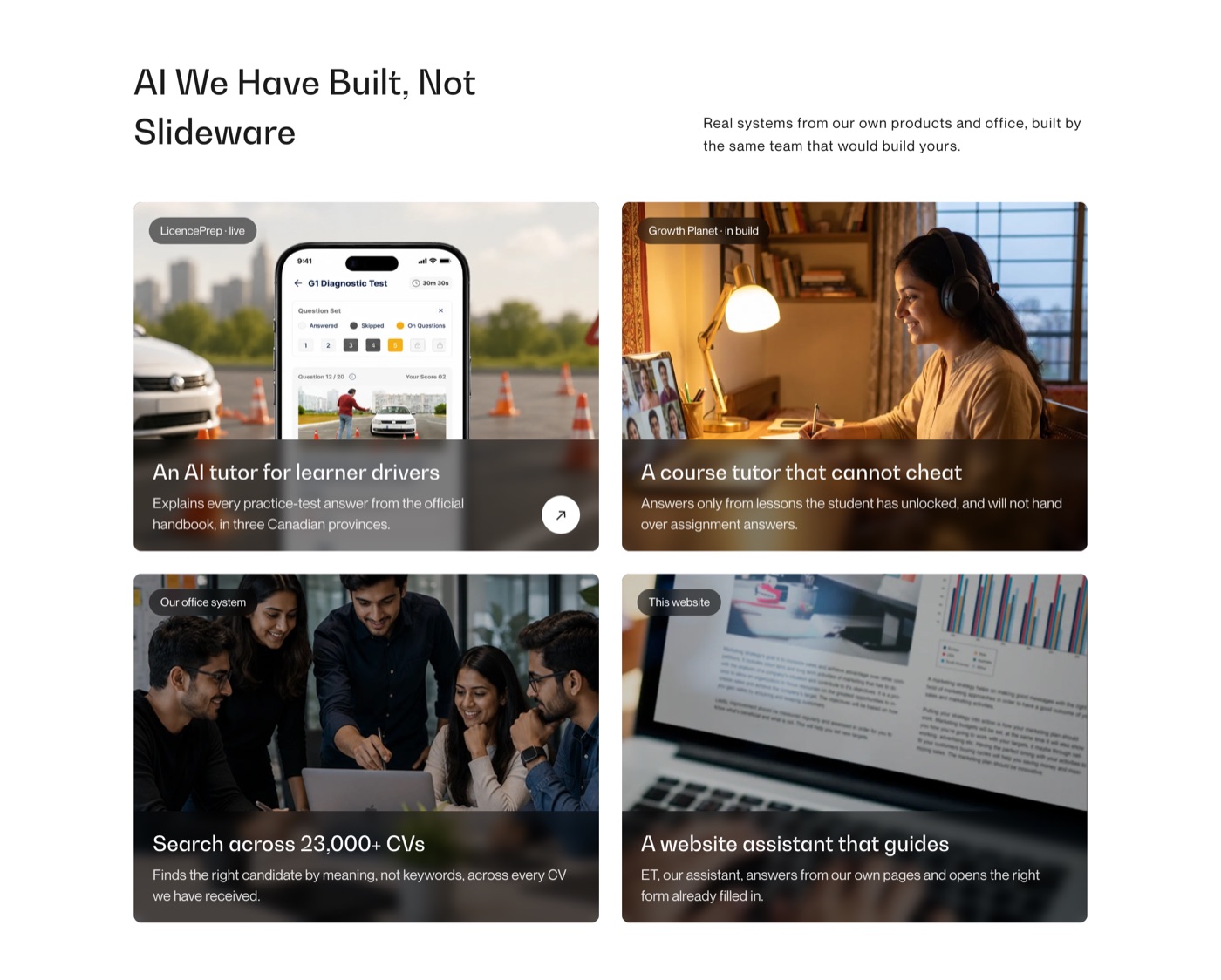
We have built this
AI we have built and run
Our office system searches more than 23,000 CVs by meaning, not keywords. LicencePrep’s tutor explains every answer from the official handbook. Growth Planet’s tutor answers only from the lessons a student has unlocked.
Want this for your business?
Ask ET on our website, or book a free 30-minute call with a project lead, not a salesperson.

