





A list of development trends is not a strategy. Each new technology, from edge computing to generative UI, represents a set of architectural trade-offs. Adopting a trend without analysing its costs can add complexity and risk to your projects. This article examines several current trends, focusing on the practical implications and compromises you should evaluate before committing your resources.
Web development
Edge computing
Edge functions, like those in Cloudflare Workers or AWS Lambda@Edge, run your code in a data centre close to the user, reducing network latency for API calls or content delivery. This is effective for tasks like A/B testing, authentication, or serving dynamic content based on geography. The trade-off is complexity. You fragment your application logic across multiple environments, which complicates debugging, and managing state becomes more difficult as you no longer have a single, centralised backend.
AI in content management systems
Integrating machine learning models into a CMS like Drupal or WordPress can automate tasks like generating image alt-text, creating content summaries, or offering SEO suggestions. The benefit is improved editor efficiency. The cost is significant. You are now responsible for the operational overhead of the AI model, including inference costs, monitoring for performance drift, and managing the data pipelines required to train or fine-tune it. There are also privacy considerations if you use customer data for personalisation.
GraphQL adoption
GraphQL gives front-end clients the power to request exactly the data they need in a single call, which can simplify state management on the client and avoid the over-fetching common with REST APIs. This is useful for mobile apps on slow networks or complex dashboards. The trade-off is a shift in complexity to the server. Your backend must now parse complex queries, guard against expensive nested queries that can cause performance issues, and implement a more granular authorisation system to protect data at the field level.
UI/UX design
Neomorphism 2.0
Neomorphism uses soft shadows and highlights to make UI elements look like they are extruding from the background. It can produce a clean, tactile interface. The trade-off is almost always accessibility. The low-contrast nature of neomorphic elements often fails WCAG contrast ratio requirements, making interfaces difficult for visually impaired users to navigate. Interactive elements can be hard to distinguish from static ones, leading to confusion and poor usability for all users.
Voice-activated UI (VUI)
Adding a voice interface allows for hands-free operation, which is critical in contexts like driving or for users with motor impairments. Building a VUI means more than just adding speech-to-text. The trade-off is the difficulty of designing for a non-visual, transient medium. You must carefully script conversations, handle ambiguous user intent, manage context across turns, and provide effective error recovery when the user cannot see the screen. It requires a completely different design and testing workflow.
Emotion AI in UX
This involves using a device's camera or microphone to infer a user's emotional state and adapt the UI accordingly, for example by changing the music in a wellness app. The potential benefit is a more responsive, personalised experience. The trade-offs are immense. The technology is often inaccurate and biased, and the ethical and privacy implications of monitoring users' emotions are significant. You risk alienating and losing the trust of your users for a feature whose value is often questionable.
Mobile development
App clips and instant apps
App Clips (iOS) and Instant Apps (Android) let users access a small part of your app's functionality on demand without a full installation from the app store. This is useful for single tasks like paying for parking or ordering food. The trade-off is development and discovery. You must build and maintain a separate, highly optimised build of your app with a size limit. Getting users to discover and launch your clip or instant app at the right moment is also a significant marketing and UX challenge.
Foldable and wearable device support
Supporting foldable screens and wearables means your app can take advantage of new form factors. For foldables, this could mean a multi-pane layout; for a watch, it could be glanceable notifications. The trade-off is a large increase in design and testing complexity. Your UI must gracefully handle changing screen sizes and aspect ratios, sometimes mid-session. For wearables, you must distil your app's core value into a tiny, low-power interface, which is a difficult design constraint.
Mobile augmented reality
Using frameworks like ARKit and ARCore, you can overlay information or virtual objects onto the real world through a phone's camera. This is used in applications from furniture placement previews to industrial maintenance guides. The trade-off is performance and content cost. AR processing is battery-intensive and can cause devices to overheat. Furthermore, creating high-quality 3D models and assets is a specialised, expensive process that is very different from standard app development.
.NET development
.NET MAUI for cross-platform apps
.NET MAUI is the evolution of Xamarin.Forms, allowing you to write C# and XAML to target Android, iOS, macOS, and Windows from a single project. The primary benefit is code reuse across platforms. The trade-off is abstraction. While MAUI has improved, you may still encounter situations where achieving platform-specific behaviour or performance requires dropping into native code, partially negating the single-codebase advantage. The framework is also less mature than native toolchains or alternatives like Flutter, so you may find fewer libraries and encounter more bugs.
Blazor Hybrid apps
Blazor Hybrid allows you to embed a Blazor web application inside a native .NET MAUI application. This lets your C# developers build the UI with web technologies without needing JavaScript. The trade-off is in the application's footprint and performance. You are packaging a web browser control and the .NET runtime within your native app, which increases its size. UI interactions also have an extra layer of abstraction to cross compared to a native UI, which can be a factor in performance-critical applications.
DevOps integration with Azure and GitHub
Using CI/CD pipelines with Azure DevOps or GitHub Actions for .NET projects automates builds, testing, and deployments. This reduces manual errors and shortens the feedback cycle. The trade-off is the initial investment and maintenance. Setting up robust, secure pipelines requires specialised expertise in infrastructure as code, YAML pipeline definitions, and environment management. These pipelines then become critical infrastructure that you must maintain, monitor, and update.
Conclusion
The right technology is the one that best solves your specific problem within your budget and team's capabilities. Each trend presents a balance of power and compromise. Edge computing offers speed at the cost of complexity. Cross-platform frameworks offer efficiency at the cost of abstraction. Adopting a new technology is an investment decision that requires a clear-eyed analysis of its costs, not just a summary of its benefits.
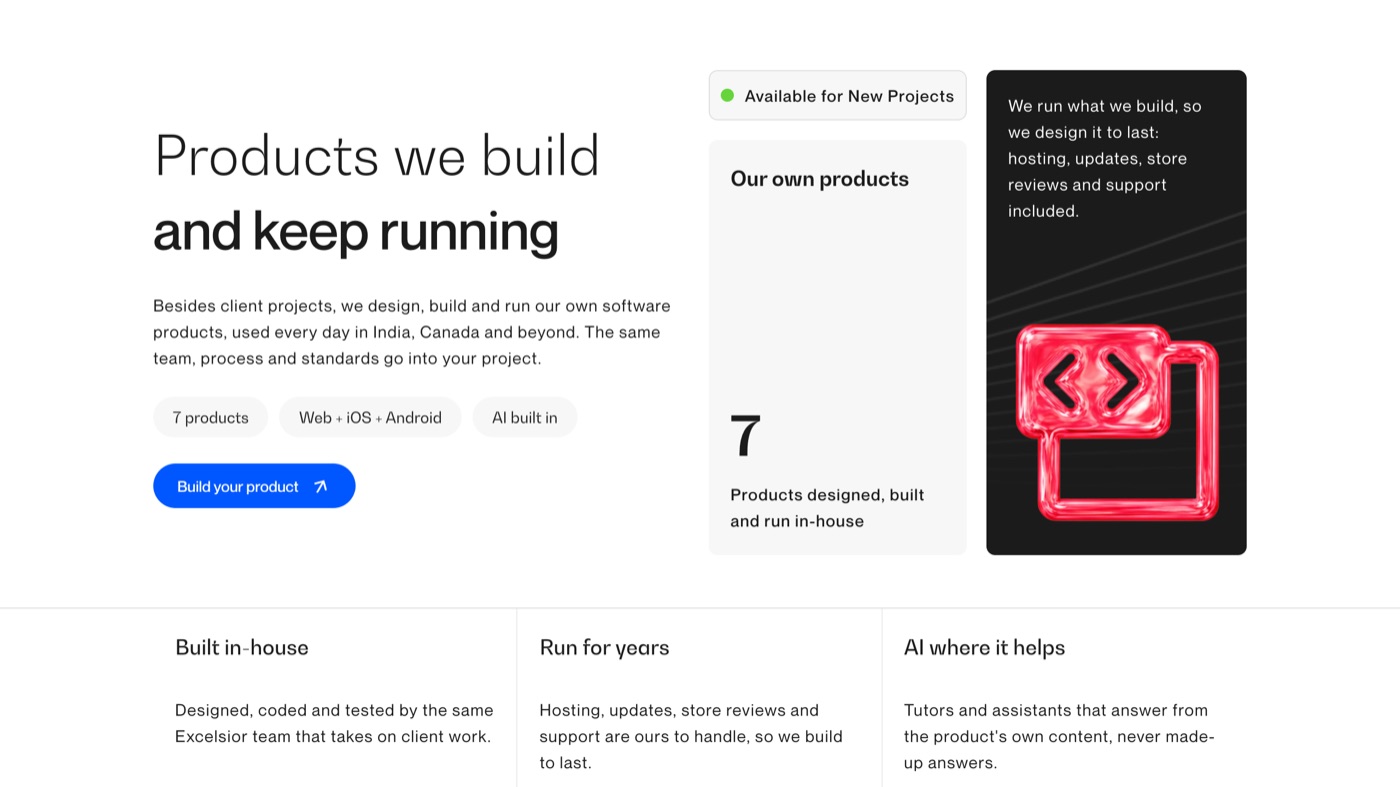
We have built this
Products we designed, built and run
LicencePrep, Lawyerly and Growth Planet are our own products: each started from one clear journey before anything else was added. You get a written scope, weekly demos of working software, and launch support from the same team.
Want this for your business?
Ask ET on our website, or book a free 30-minute call with a project lead, not a salesperson.

