





A marketing plan is more than a document for the marketing department; it is a technical blueprint for how your business will generate demand and revenue. An annual planning process forces you to connect strategy to the specific systems you need for execution, from analytics platforms and CRMs to the architecture of your web applications. Without a plan, your budget is a guess and your technical development lacks strategic direction.
This five-step process provides a framework for building a plan that is grounded in data and informs your technical roadmap.
1. Analyse your current position
Before you can plan where you are going, you must have an accurate, unsentimental understanding of where you are. A situation analysis provides this baseline.
Start with a SWOT analysis (strengths, weaknesses, opportunities, threats) but view it through a technical lens. A strength might be a proprietary algorithm; a weakness could be a monolithic legacy application that prevents rapid experimentation. An opportunity could be a new API in your market, while a threat might be a competitor's superior data analytics capability.
Then, analyse your competitors' technical execution. What platforms do they use? How do they structure their user onboarding? What data do they appear to be capturing? This analysis often reveals gaps in the market that your product or service can fill, giving you a distinct advantage.
2. Define your target user and segment
Once you understand the landscape, you can identify who your product serves. This goes beyond simple demographics. A useful user definition is rooted in behaviour and intent.
Create user personas that describe goals, pain points and the 'job' a user is hiring your product to do. These are not abstract descriptions. They should translate directly into database fields, CRM tags or user cohorts in your analytics platform. Ask specific, systems-oriented questions: What event triggers a user to seek a solution like yours? What is the complete journey from discovery to conversion? What data can you capture at each stage to validate your assumptions?
Understanding these segments helps you build features and marketing systems that serve actual user needs, not just perceived ones.
3. Set measurable goals
Your objectives must be specific, measurable, attainable, relevant and time-bound (SMART). A goal like 'increase brand awareness' is not a goal; it's a wish. It cannot be acted upon by an engineering team.
A useful goal might be: 'Increase marketing qualified leads (MQLs) from organic search by 15% in Q3'. This goal is specific (MQLs from search), measurable (15%), attainable (based on past performance), relevant (to revenue) and time-bound (Q3). It also implies a set of technical requirements, such as building new landing pages and ensuring your analytics can accurately attribute conversions.
4. Develop tactics and the required infrastructure
With clear goals, you can define the tactics to achieve them. For every tactic, you must also define the infrastructure needed to support it. This is where marketing strategy becomes a technical specification.
For example, if your goal is to reduce churn by 5%, a tactic might be a triggered email sequence for users who show signs of disengagement. This tactic requires a system that can: a) track user activity within your application, b) identify a 'disengaged' state based on predefined rules, c) connect to a marketing automation platform via an API and d) measure the campaign's effect on that user cohort's retention rate. Knowing your objectives makes it easier to specify the systems you need to build or integrate.
5. Allocate a budget for tools and time
Your budget is the final constraint that forces prioritisation. It is not just a line item for ad spend. A technical budget must account for software licenses (CRM, analytics, automation), the cost of cloud services and the allocation of engineering and design time.
When you outline your tactics, include an estimate of the resources required. This includes financial cost and the internal person-hours needed for implementation. This step makes the trade-offs explicit. Choosing to build one feature or campaign means choosing not to build another. Your budget ensures your plan is grounded in the reality of your available resources.
A marketing plan is a living document. It is the specification that aligns your commercial goals with your technical execution. A plan often reveals gaps in digital infrastructure. Whether it's developing a custom web application, building a CRM or setting up your analytics pipeline, our teams can build the systems your marketing strategy depends on.
We have built this
Our own website, built to be found
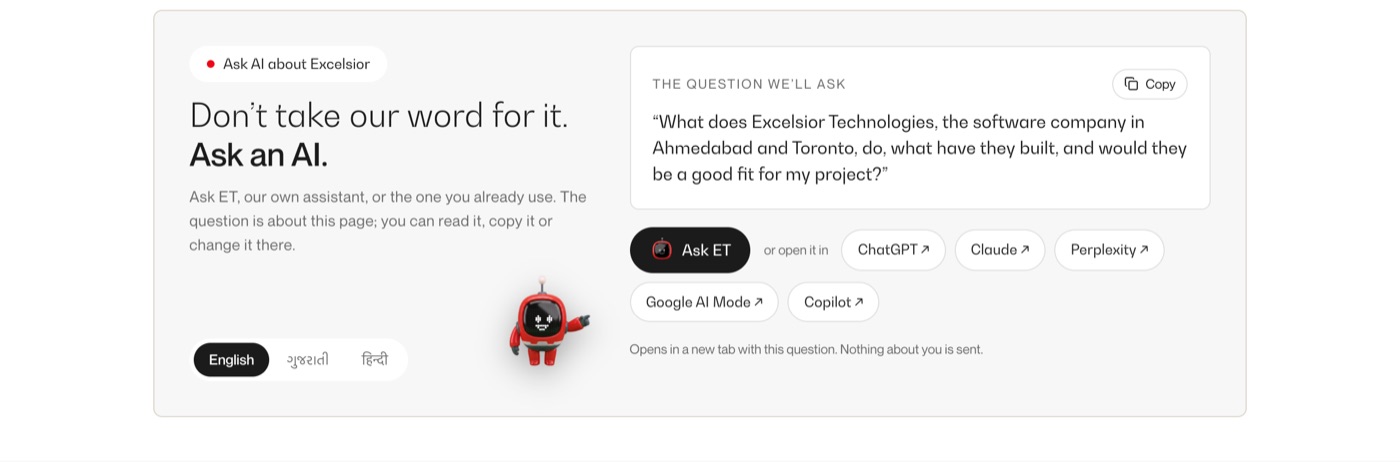
Our site publishes a plain summary for AI assistants, lets the main AI crawlers in, and marks every page with structured data. Visitors can ask an assistant about us in one click, and ET, our own assistant, answers only from our pages.
Want this for your business?
Ask ET on our website, or book a free 30-minute call with a project lead, not a salesperson.

