





Acquiring traffic for an e-commerce store is often framed as a marketing expense. The technical implementation of the platform itself however is a primary factor in its ability to attract users organically. For product owners and engineering managers, the choices made in development directly influence search engine visibility and user engagement.
This article outlines five technical strategies for increasing website traffic that focus on engineering and design rather than advertising spend.
1. Build referral and loyalty features
Referral and loyalty programmes are not just marketing initiatives but software features that require careful implementation. Instead of relying on third-party plugins that can slow down your site and offer limited customisation, building this logic into your platform gives you full control.
Developing a custom module allows you to define the rules for earning and redemption. This involves generating unique referral codes, tracking conversion attribution through the user journey and applying rewards or discounts at checkout via API calls. This approach keeps the user experience consistent and avoids the performance overhead of external scripts.
2. Architect for content-driven commerce
Regularly publishing content helps search engines index your site for relevant keywords. Most e-commerce platforms like Shopify or BigCommerce offer built-in blogging functions. These are simple to start with but can be restrictive in terms of performance and design flexibility.
A more technically robust approach is to use a headless content management system (CMS). This decouples your content from your e-commerce backend, allowing you to build a faster, statically generated blog that makes API calls to your product catalogue. This architecture gives you superior performance, which is a key factor for search engine ranking, and greater control over the user experience.
3. Optimise the on-page experience
Core Web Vitals
Google uses Core Web Vitals (CWV) as a direct ranking signal. This means your Largest Contentful Paint (LCP), First Input Delay (FID) and Cumulative Layout Shift (CLS) scores affect your visibility. Optimising these requires technical work such as image compression, code splitting to reduce blocking time and reserving space for UI elements to prevent layout shifts.
Mobile-first indexing
Google predominantly uses the mobile version of a site for indexing and ranking. A responsive design is not sufficient. You must ensure that the mobile view contains the same content, structured data and functionality as the desktop version and that it is optimised for touch targets and viewport dimensions.
User-friendly navigation
Site structure impacts both user retention and search engine crawling. A logical hierarchy, clear breadcrumbs and an intuitive search function reduce friction and help users find products. This keeps them on the site longer, sending positive engagement signals to search engines.
4. Reduce friction in the checkout flow
Expose costs early
A high number of abandoned carts can be attributed to unexpected costs. Your system should be designed to calculate and display shipping fees and taxes on the cart page, not just at the final step. This requires API integrations with shipping carriers and tax calculators that respond quickly without delaying page load.
Reduce steps to conversion
Each click and form field is a potential point of failure. A single-page checkout built with a framework like React or Angular can contain the entire process in one view, reducing the perceived effort. You can also pre-fill user information for returning customers and use address lookup APIs to minimise manual entry.
Offer multiple payment gateways
Integrating several payment options like Stripe, PayPal and digital wallets caters to user preference and can improve conversion rates. The implementation should handle callbacks and transaction states securely without redirecting the user more than necessary, providing a smooth and contained experience.
5. Implement structured data
Structured data, using a vocabulary like Schema.org, allows you to add context to your content for search engines. This is not visible to users but can significantly improve your appearance in search results.
By marking up your product pages with Product schema, you can enable rich snippets that show price, availability and review ratings directly in Google's results. Implementing BreadcrumbList schema helps Google understand your site structure and can display it in search results. This increased visibility in the search engine results page improves click-through rates, driving more qualified organic traffic.
We build the e-commerce platforms and custom features that support these strategies. Our teams in Ahmedabad and Ontario deliver e-commerce development, UI/UX design and digital marketing services.
We have built this
Our own website, built to be found
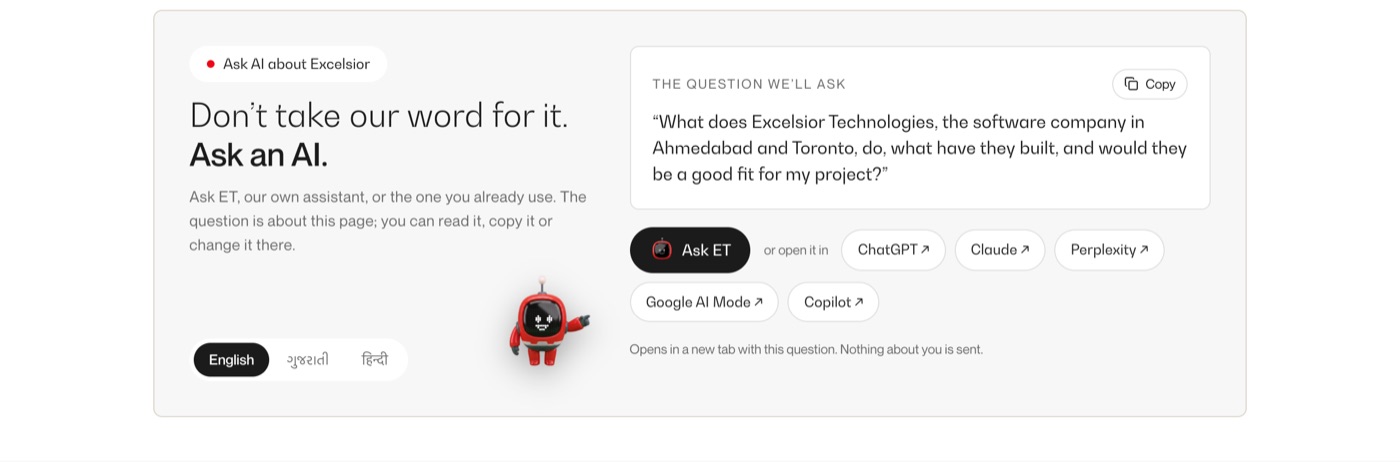
Our site publishes a plain summary for AI assistants, lets the main AI crawlers in, and marks every page with structured data. Visitors can ask an assistant about us in one click, and ET, our own assistant, answers only from our pages.
Want this for your business?
Ask ET on our website, or book a free 30-minute call with a project lead, not a salesperson.

