

Evaluating marketing effectiveness after a campaign has run tells you where your budget went. A SWOT analysis tells you where it should go next. It is a structured audit of your internal and external landscape, designed to inform strategy before you commit resources to development or advertising.
Instead of relying only on lagging indicators like return on investment or cost per click, this framework helps you make strategic decisions based on a complete view of your position in the market. It forces an honest assessment of your capabilities and the external factors that affect them.
How to conduct a marketing SWOT analysis
First, define the scope. You can run a SWOT analysis on your entire marketing function, a single product line, or even a specific upcoming campaign. A broader scope gives strategic direction for the business, while a narrow scope provides tactical guidance for a project. The process is the same, but the questions you ask will change.
The goal is to document clear, specific points in each of the four quadrants. Vague statements are not actionable. "Good brand reputation" is a weak point. "Our GitHub repository is the most cited source for our niche on Stack Overflow" is a strength you can build on.
The four components of a SWOT analysis
Strengths (Internal, Positive)
Strengths are the internal resources and capabilities you control that give you an advantage. They are what you do well. Go beyond surface-level claims and identify tangible assets.
- What proprietary technology, data or algorithms do you own?
- Which of your web or mobile applications have the highest user engagement?
- What is your unique selling proposition and is it clearly supported by your product's features?
- Which digital channels consistently deliver the lowest cost per acquisition?
- What aspects of your UI/UX do users praise most often?
Weaknesses (Internal, Negative)
Weaknesses are internal factors that put you at a disadvantage. This is often the hardest part of a SWOT analysis because it requires objective self-criticism. Acknowledging technical debt, process failures or skill gaps is necessary for improvement.
- What are the most common complaints in user reviews or support tickets?
- Where in your sales or user onboarding funnel do most people drop off?
- What technical debt exists in your marketing platforms or primary application?
- Does your current tech stack create friction for users or slow down development?
- Are there gaps in your team's expertise, for example in cloud and DevOps or a specific mobile framework like Flutter or React?
Opportunities (External, Positive)
Opportunities are external factors you can potentially use to your advantage. These are not just ideas for improvement but observable trends, market shifts or competitor missteps you can act upon.
- What emerging technology could improve your product or marketing reach?
- Could a change in your app's architecture, such as a move to microservices, open up new integration possibilities?
- Are there underserved customer segments your competitors are ignoring?
- Which marketing messages are most effective with your clients and could you use them across more platforms?
- Are there new regulations or standards that your product already meets, which could become a selling point?
Threats (External, Negative)
Threats are external factors that could harm your business. The aim is to identify them early and plan a response before they become critical problems. A threat might be a direct competitor action or a wider market shift.
- What are your competitors' key technical advantages?
- How will regulatory changes, like the phase-out of third-party cookies, affect your data collection and retargeting strategy?
- Is a core technology you rely on, such as a specific version of PHP or ASP.NET, becoming obsolete or less supported?
- Are there negative economic trends that might affect your clients' budgets?
- Could a new platform or device change user expectations in a way your current product cannot meet?
From analysis to action
A completed SWOT grid is not the end of the process. The next step is to use it to define strategic priorities. Combine the quadrants to guide your decisions.
- Strength-Opportunity: Use an internal strength to act on an external opportunity. For example, use your strong SEO presence (Strength) to create content for a new market segment (Opportunity).
- Weakness-Threat: Act to prevent an external threat from exploiting an internal weakness. For instance, if your mobile app is slow (Weakness) and a competitor is launching a faster one (Threat), app performance optimisation becomes an urgent priority.
- Strength-Threat: Use a strength to mitigate a threat. If new privacy laws are introduced (Threat), your robust first-party data system (Strength) becomes a major asset.
- Weakness-Opportunity: Identify weaknesses you must address to pursue an opportunity. To target a new user demographic (Opportunity), you may first need to fix your confusing onboarding process (Weakness).
A rigorous SWOT analysis clarifies where to invest your marketing and development resources. If your findings point to a need for a new web application, a mobile app for iOS or Android or a targeted digital marketing campaign, our teams in Ahmedabad and Ontario have experience delivering these systems. We have published eleven case studies detailing our work for clients like Univia, Angel EduNext and LicencePrep.
We have built this
Our own website, built to be found
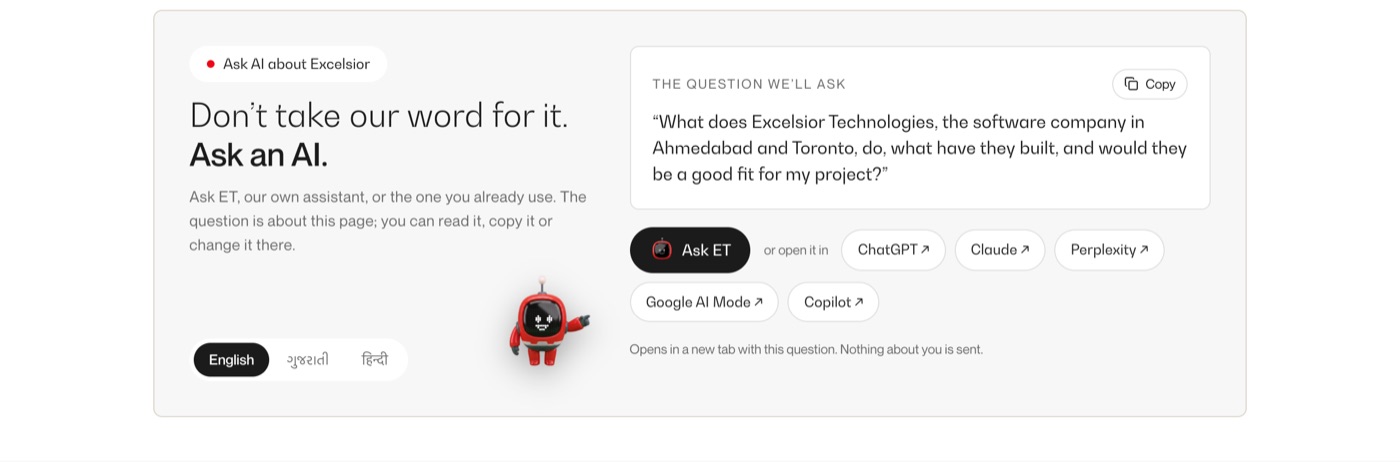
Our site publishes a plain summary for AI assistants, lets the main AI crawlers in, and marks every page with structured data. Visitors can ask an assistant about us in one click, and ET, our own assistant, answers only from our pages.
Want this for your business?
Ask ET on our website, or book a free 30-minute call with a project lead, not a salesperson.