In 30 seconds
- AI assistants answer from what they can read about you: your website first, then listings and reviews.
- If your site is slow, vague or locked behind scripts, the assistant guesses, or names a competitor.
- A few plain changes (clear facts, a summary file for AI, open access for AI crawlers) make the answer accurate.
Ask any business owner where their last good lead came from, and you will hear “Google”, “a referral” or “LinkedIn”. More and more, the honest answer is “they asked an AI first”. A buyer types a question into ChatGPT, Gemini, Perplexity or Copilot, reads a short answer, and only then visits two or three websites. If your business is not in that answer, you are not on the shortlist.
The assistants are not mysterious. They answer from what they can read, and most of that is your own website.
What a buyer sees
Here is the same buying question asked twice: once about a business whose facts are vague and inconsistent, and once after the facts are fixed.
How it works
What happens when a buyer asks an AI about you
The steps, in words
- A buyer asks: “Which software company in Ahmedabad builds apps with AI?”
- The assistant searches: It looks for pages that answer the question directly, in plain words.
- It reads your site: Services, case studies, locations, reviews, and any summary file you publish for AI.
- It compares sources: Your site, listings, reviews and articles: facts that agree win.
- It answers, with or without you: If your facts were clear and consistent, you are named. If not, someone else is.
Where AI assistants get their answer about you
When an assistant answers a buying question, it searches the web the way a careful researcher would, then summarises what it found. It leans on four things.
Facts said plainly
“We build Flutter apps for iPhone and Android” beats “We craft delightful digital journeys”.
Facts that agree
The same address, services and founding year on your site, your Google profile and your listings.
Pages that can be read
Pages that load fast and show their text without waiting for heavy scripts.
Proof
Named projects, case studies and reviews give the assistant something concrete to repeat.
When those are missing, the assistant fills the gap with whatever it can find: an old directory listing, a competitor’s page, or a polite “I could not find details about this company”.
What an assistant can repeat
- “We build iPhone and Android apps for clinics in Ahmedabad”
- A case study that names the client and the problem solved
- The same phone number and address everywhere
- A short summary for AI at /llms.txt
What makes it skip you
- “Innovative digital solutions”
- A wall of client logos with no story
- Three different addresses across your listings
- Pages whose text appears only after heavy scripts load
The five changes that make the answer accurate
- Write your services the way buyers ask. One page per service, with the question it answers in the first lines: what it is, who it is for, what it costs to start, how long it takes.
- Publish a summary file for AI. A short text file at /llms.txt that lists who you are, what you do, where you are and your key pages. Assistants that look for it get a clean, current picture.
- Let the AI crawlers in. Many sites block them by accident. Your robots.txt should allow the assistants you want to be found by.
- Mark your pages with structured data. Organization, services, case studies, breadcrumbs and FAQs, in the format search engines read.
- Make every fact consistent. Address, phone, founding year, service names: the same everywhere. Conflicting facts are the fastest way to be left out.
What this looks like on a real site
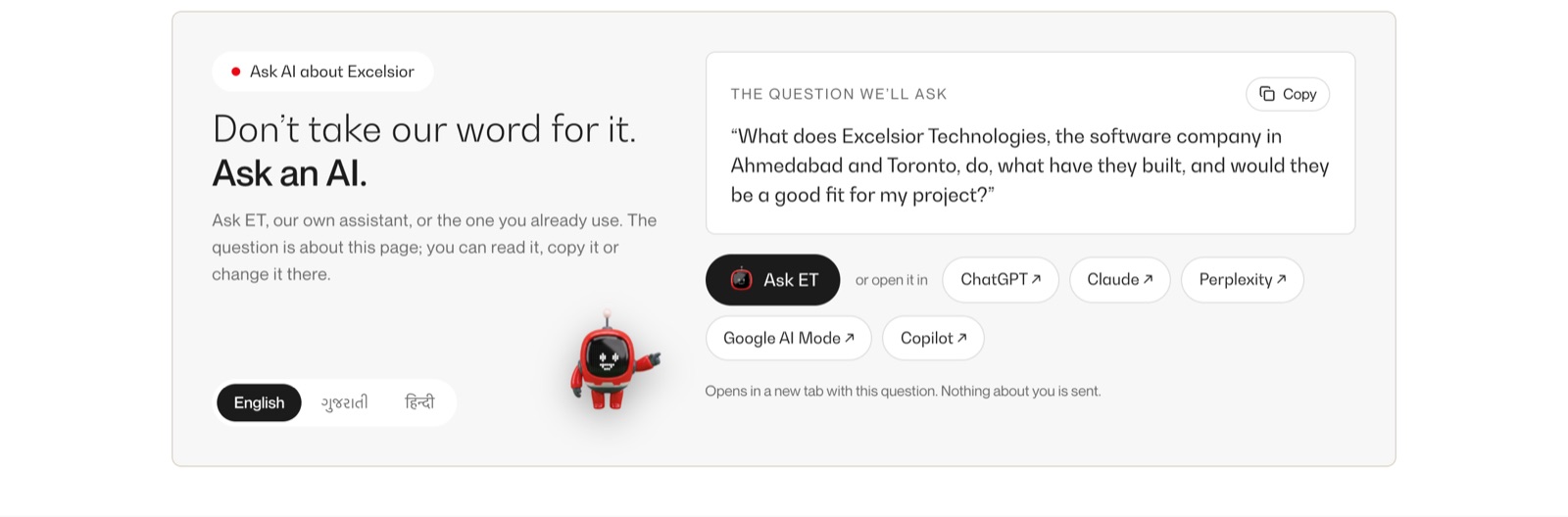
We made these changes on our own website this autumn, so we could see the difference ourselves. Every service and case study page now states its facts plainly, the site publishes a summary for AI in English, Gujarati and Hindi, and every page carries structured data. We even added a section that opens ChatGPT, Claude, Perplexity, Google AI Mode or Copilot with a question about us already written, so visitors can check our claims with the assistant they trust.
We have built this
Our own website, built to be read by AI
Our site publishes a plain summary for AI assistants (llms.txt, with Gujarati and Hindi versions), lets the main AI crawlers in, and marks every page with structured data.
Visitors can even ask an assistant about us in one click, with the question already written. ET, our own assistant, answers only from our pages.
How to check what AI says about you today
It takes five minutes, and it is worth repeating every month.
- Minute 1Ask
Ask two or three assistants: “Who are the best [your service] companies in [your city]?” and “What does [your business] do?”
- Minute 3Note
What is right, what is wrong, and what is missing.
- Minute 5Check the link
Does the answer link to your site, and to which page?
- Next monthAsk again
Repeat after your changes, and compare.
If the answers are thin or wrong, the fix is almost always on your own website, which is good news: it is the one source you control completely.
Frequently asked questions
Is this the same as SEO?
It overlaps. Clear pages, structured data and consistent facts help both Google results and AI answers. The difference is that an assistant gives one summarised answer instead of ten links, so being clearly described matters even more.
Do I need a new website to be found by AI?
Usually not. Most of the work is rewriting key pages in plain words, adding structured data and a summary file, and fixing what blocks crawlers. A rebuild only makes sense if the site is very slow or cannot be edited.
Can I pay to appear in ChatGPT or Gemini answers?
Not in the answers themselves today. What you can do is make your business easy to understand and easy to verify, which is what the assistants reward.
How long until the answers change?
Assistants that search the web live can reflect changes within days. Others refresh what they know less often, so expect a few weeks for the full effect.
Want this for your business?
Ask ET on our website, or book a free 30-minute call with a project lead, not a salesperson.