




In 30 seconds
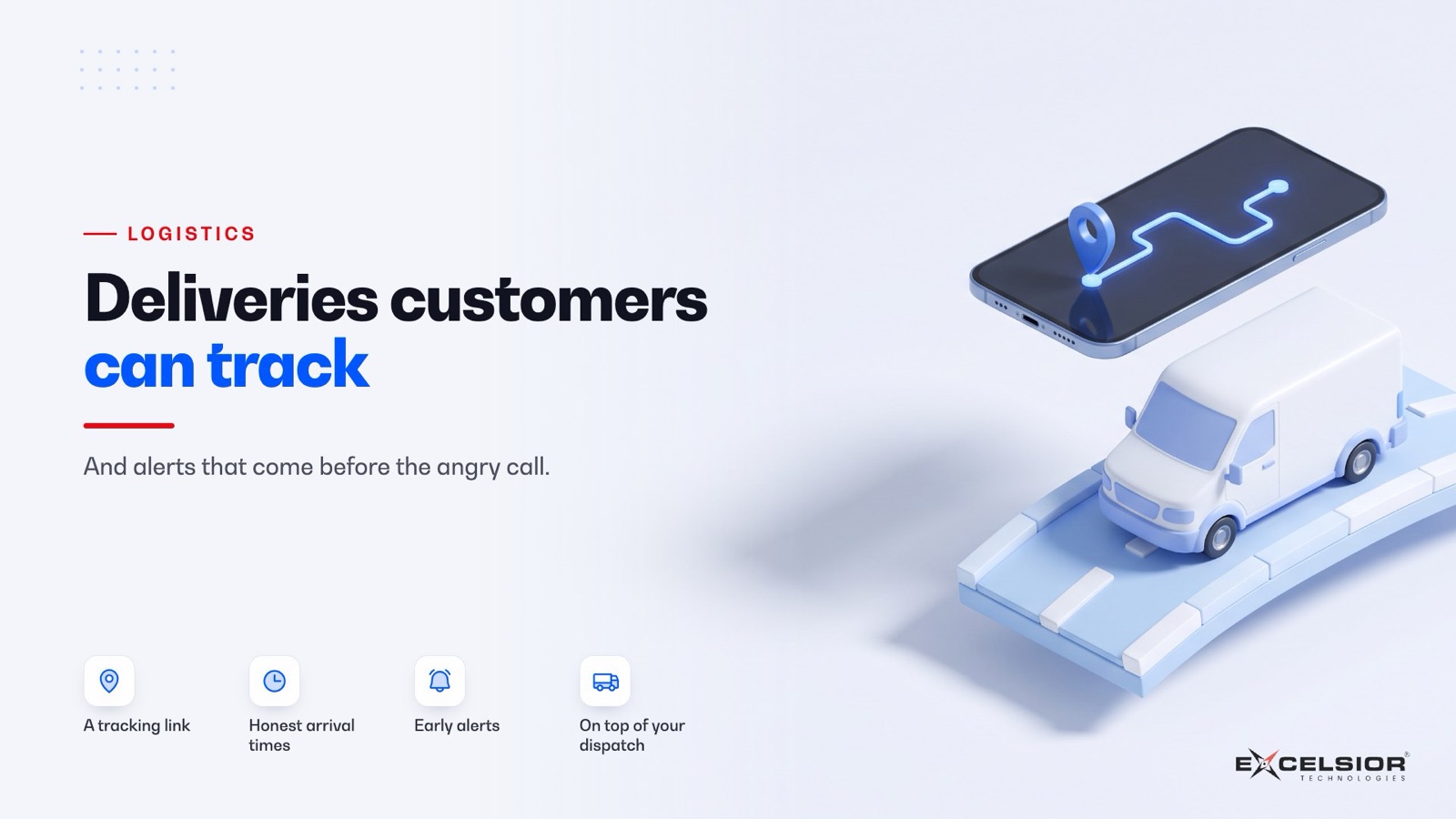
- Customers mostly call because they do not know. A tracking link and honest arrival times remove most of those calls.
- AI is useful one step earlier: spotting the delivery that will be late, and telling the customer and your team before anyone asks.
- You do not need to replace your dispatch system. Tracking and alerts can sit on top of it.
Ask a support team at any delivery business what their most common call is, and the answer is almost always the same: “Where is my order?” Most of those calls are not complaints. They are uncertainty.
The calls that hurt are the late deliveries nobody saw coming.
From dispatch to “delivered”, with no surprise calls
How it works
From dispatch to “delivered”, with no surprise calls
The steps, in words
- Order dispatched: The customer gets a tracking link by SMS or WhatsApp.
- Live position and arrival time: Updated from the driver’s phone or vehicle tracker.
- AI spots a likely delay: Traffic, a long stop or a missed slot: it predicts the late arrival.
- Everyone is told early (a person decides): A new time for the customer, an alert for dispatch.
- Proof of delivery: Photo, signature or OTP, shared instantly.
Step 1: remove the uncertainty
A tracking link
sent the moment the order leaves, by SMS or WhatsApp.
An honest arrival window
, updated as the day goes on, not a promise made at 8 a.m.
A heads-up before arrival
“Your driver is 15 minutes away.”
Proof of delivery
a photo, signature or OTP, shared straight away.
These alone remove a large share of calls, because the customer already knows.
Step 2: let AI warn you early
The calls that hurt are the late deliveries nobody saw coming. AI is good at spotting them early by reading the signals your systems already have:
| Signal | What it suggests |
|---|---|
| A long stop at one address | The rest of the route will run late |
| Traffic on the next leg | The next slot will be missed |
| A driver behind schedule by midday | Afternoon deliveries need moving |
| Repeated failed deliveries in an area | A route or timing problem |
When the model predicts a delay, the customer gets a new time and dispatch gets an alert, before anyone picks up the phone.
In practice
A late delivery that nobody calls about
Say a van leaves the warehouse at 2 p.m. with a 4:10 p.m. arrival for a customer.
- 2:00 p.m. The customer gets a tracking link by SMS.
- 3:20 p.m. Traffic ahead slows the van. The model predicts arrival at 4:35.
- 3:21 p.m. The customer gets the new time, and dispatch gets an alert, before anyone picks up the phone.
- 4:33 p.m. Delivered, with an OTP and a photo, shared instantly.
The delivery was still late. The angry call never happened.
On top of what you already run
You do not need a new dispatch system. Tracking, alerts and customer messages can connect to your existing order and route data through an API or a regular export, and to drivers through a simple app.
We have built this
Early warnings are what we build
Our Mumbai flood twin, in development, reads live conditions and warns before trouble reaches the street. Delay alerts for deliveries work the same way: read the signals, predict the problem, tell the right people early.
We build tracking, alerts and customer messages on top of the systems a business already runs.
Where to start
Begin with the tracking link and live arrival times for one city or one customer segment. Measure “where is my order?” calls for a month. Then add delay prediction, starting as alerts to dispatch only, before any message goes to customers automatically.
Frequently asked questions
Do drivers need a special device?
Usually a smartphone app is enough. Vehicle trackers can be connected if you already use them.
Can messages go on WhatsApp?
Yes, through the official WhatsApp Business Platform with approved templates, or by SMS.
Will it work with our current software?
In most cases, through its API or data exports. We check before quoting.
How accurate are delay predictions?
They improve with history. Start with alerts to your team only, and automate customer messages once they prove reliable.
Want this for your business?
Ask ET on our website, or book a free 30-minute call with a project lead, not a salesperson.

