





Facebook Messenger is an instant messaging application from Meta. Its scale makes it a candidate for business communication, but its utility is not in manual chat. The platform's value comes from its APIs, which allow you to treat Messenger as a programmable channel for lead capture, support and transactions.
This article covers the technical implementation of Messenger for business. We will discuss how to integrate it with your existing software, the architectural considerations for handling message volume and the trade-offs of building on a third-party platform.
Integrating Messenger with business systems
Using Messenger effectively means moving beyond the standard inbox. Programmatic integration allows you to automate responses, capture data and connect conversations to your other systems like a CRM or e-commerce backend.
This is primarily achieved via the Messenger Platform API and webhooks. When a user messages your page, Facebook sends a payload of data to a webhook endpoint you control. Your application can then process this message, query your own databases or APIs and send a reply back through the Messenger API. This architecture is the foundation for any custom Messenger automation.
Use cases for API integration
Lead capture and CRM integration
A conversation is a structured way to qualify a lead. A bot can ask for a user's name, email, company and specific interest, validating the input at each step. Once collected, this data can be pushed directly into your CRM via its API, creating a new lead record without manual data entry. This bypasses spreadsheets and reduces the risk of human error.
Automated support and human handover
A well-designed chatbot can handle common queries by identifying user intent and pulling answers from a knowledge base. For complex issues, the bot can collect initial information and then seamlessly transfer the conversation to a human agent. The agent receives the full context, so the user does not have to repeat themselves. This requires an architecture that can manage conversational state and route messages between the bot and your support desk software.
In-chat transactions
The Messenger Platform supports native payment flows. You can present products in a webview, allow users to add items to a cart and complete a purchase without leaving the application. This requires backend integration with your payment processor and e-commerce system to handle inventory, order creation and transaction security.
Architectural considerations
Building a reliable Messenger integration requires more than just API calls. You need to consider how your system will scale and how users will find it.
The trade-off: building on rented land
Using Messenger gives you access to a massive user base with low friction. The cost is platform dependency. You are subject to Meta's API rate limits, feature changes and content policies. An API update could break your integration, and a policy change could render your entire use case invalid. Data you collect is also subject to their terms. You do not own the channel, which is a significant business risk to weigh against the convenience.
Measurement and analytics
Facebook provides basic interaction metrics, but they lack depth. You cannot easily join this data with your own application analytics or sales figures. A better approach is to have your webhook post events to your own data warehouse. This lets you track the entire user journey, from the initial message to a final conversion, and calculate metrics like cost per qualified lead or the impact of bot automation on support ticket volume.
Integrating Messenger programmatically is a software development project. If you need a team to build the backend services, integrate with your CRM or develop a custom AI chatbot, we can provide dedicated developers to manage the work.
We have built this
Our own website, built to be found
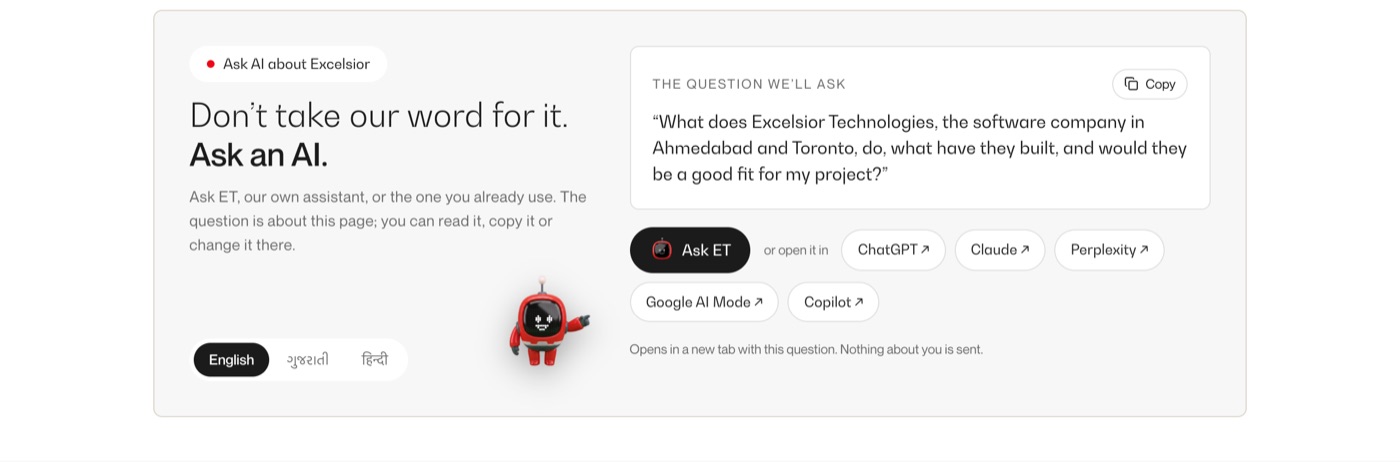
Our site publishes a plain summary for AI assistants, lets the main AI crawlers in, and marks every page with structured data. Visitors can ask an assistant about us in one click, and ET, our own assistant, answers only from our pages.
Want this for your business?
Ask ET on our website, or book a free 30-minute call with a project lead, not a salesperson.

