
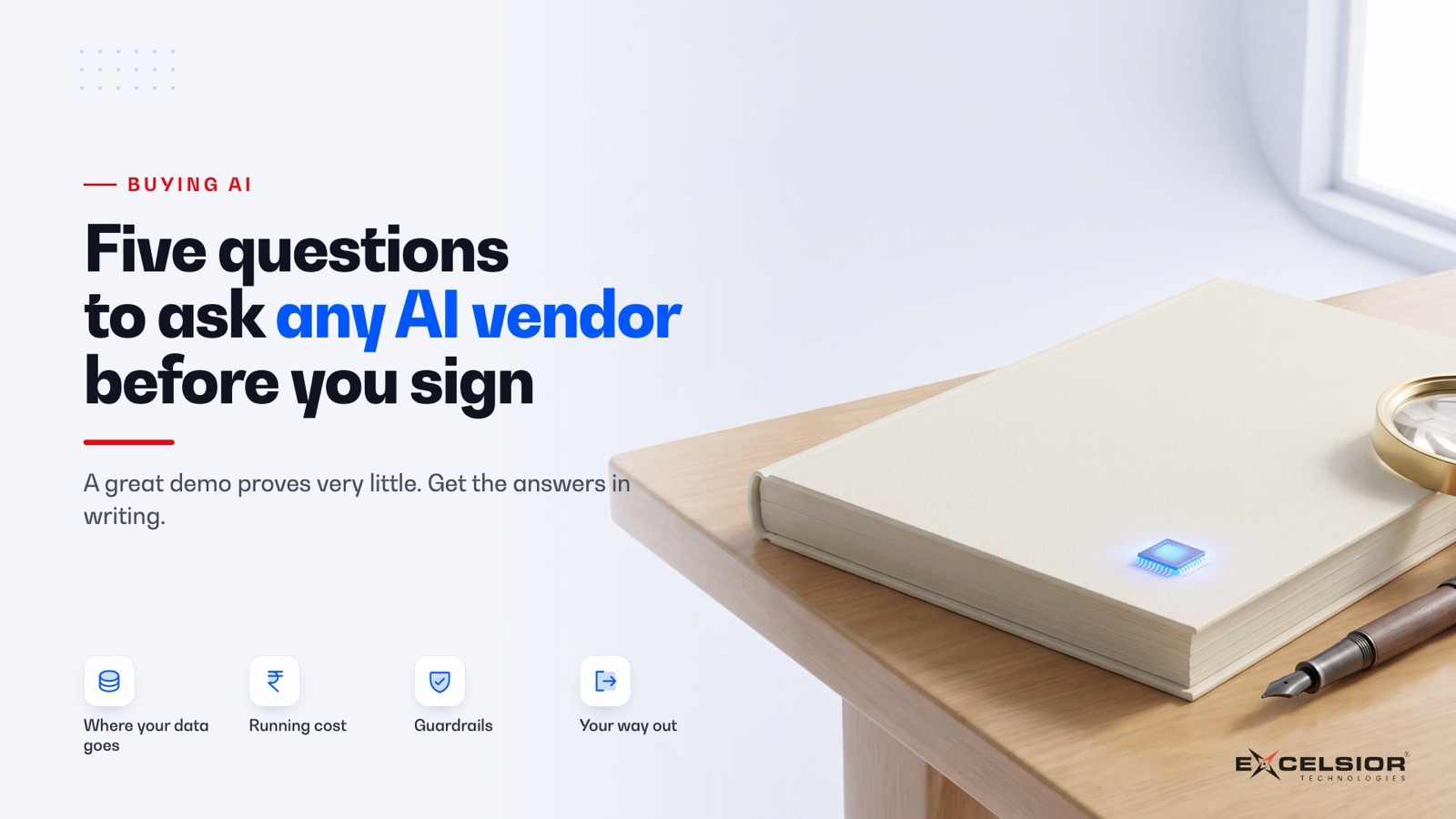
In 30 seconds
- A great demo proves very little. Ask what happens to your data, what it costs to run every month, and who owns what is built.
- Good vendors answer specifically and in writing. Vague answers about data and costs are the biggest warning sign.
- Plan your exit before you sign: you should be able to take your data, prompts and code elsewhere.
Every AI vendor has an impressive demo. Demos run on clean sample data, with a script, in the best case. What you are really buying is everything the demo does not show: how your data is handled, what it costs to run every month, and what happens if you want to leave.
A demo shows the best case. The contract has to cover every other day.
From demo to a decision
The five questions below fit into a simple path: ask, get the answers in writing, test on your own data, then sign only for what worked.
How it works
From demo to a decision you will not regret
The steps, in words
- See the demo: Useful, but it shows the best case on sample data.
- Ask the five questions (a person decides): Data, running cost, ownership, exit, support. In writing.
- Run a small pilot on your data: One task, a few weeks, a number to measure.
- Check the result with your team (a person decides): Did it save time? Were the mistakes caught?
- Sign for what worked: Scale only the part that proved itself.
1. Where does our data go, and who can see it?
Ask where your data is processed and stored, whether it is used to train anyone’s model, and who on their side can access it.
Good answer
- “It runs in your own cloud account, or in a business AI service that does not train on your data. Only these named roles can access logs, and we can show you the settings.”
Warning sign
- “Don’t worry, it’s all secure.”
2. What will it cost to run, every month?
The build is one cost. AI services charge per use, and costs grow with your users.
Good answer
- A monthly estimate at your current volume and at double it, and the levers that keep it down: caching, smaller models for simple tasks, limits.
Warning sign
- A price for the build, and silence about running costs.
3. Who owns what you build for us?
The code, the prompts, the configuration and the data you collect.
Good answer
- “You own the code and prompts we write for you, and your data is always yours.”
Warning sign
- Everything locked inside the vendor’s own platform, with no export.
4. How do we leave if we need to?
Plan the exit before you sign. It keeps everyone honest.
Good answer
- A handover list: source code, documentation, data export, and which AI model or service it can move to.
Warning sign
- “Why would you want to leave?”
5. Who fixes it when it is wrong, and how fast?
AI systems need tuning after launch. Wrong answers will happen; what matters is how quickly they are caught and fixed.
Good answer
- A named team, a response time, a way to report a bad answer, and a regular review of mistakes.
Warning sign
- Support that ends at go-live.
We have built this
The guardrails we build by default
Models inside your own cloud so your access rules still apply, personal details hidden before a prompt is sent, every answer checked before anyone sees it, and risky actions waiting for a person.
Ask us for them in writing, so you can hold any vendor to them, including us.
Then run a small pilot
Even with good answers, start small.
- Week 1One task
Pick one task and one number to measure, on your real data.
- Weeks 2–4Run it
Your team uses it for real and flags every wrong answer.
- Week 5Check together
Did it save time? Were the mistakes caught?
- ThenSign for what worked
Scale only the part that proved itself.
Frequently asked questions
Should we choose a big AI platform or a custom build?
Platforms are quick for standard tasks. A custom build makes sense when the AI must work with your own systems and rules. Many businesses use both: a platform for general writing, a custom assistant for their own data.
How long should a pilot run?
Long enough to see real volume and real mistakes, typically a few weeks for a task that happens daily.
What should be in the contract?
Data handling and training terms, running-cost estimates, ownership of code and prompts, an exit and handover clause, and support response times.
Can Excelsior review another vendor’s proposal?
Yes. Send it with our free AI readiness check and we will tell you what to ask about, even if you do not build with us.
Want this for your business?
Ask ET on our website, or book a free 30-minute call with a project lead, not a salesperson.