





Test automation is a standard practice for reducing release cycle times, but writing and maintaining test suites is a significant engineering cost. Google's Gemini, a large language model (LLM), can be applied to parts of this process. It does not run tests, but it can write the code that does, acting as an assistant to your development and QA teams.
This guide explains the specific tasks where Gemini can assist, how it integrates into a typical development workflow and the limitations you must consider.
How Gemini can assist test automation
Test case generation
From a user story, a code diff or a function signature, Gemini can generate corresponding test cases in your chosen framework, such as Pytest, Jest or JUnit. This reduces the time spent on writing boilerplate test code, freeing up developers to focus on the application's core logic. The output always requires human review.
Edge case discovery
An LLM can suggest test scenarios that a human tester might not immediately consider. By prompting it with the system's specifications, you can ask it to brainstorm potential edge cases, invalid inputs and unusual user behaviour paths. This helps improve test coverage beyond the most obvious success and failure conditions.
Test data creation
You can use Gemini to generate large and varied datasets for testing. This is useful for populating a development database or for creating inputs for performance and load testing. It can produce data in formats like JSON, CSV or SQL, tailored to a specified schema.
Explaining test failures
When a test in a CI/CD pipeline fails, Gemini can help interpret the results. By providing it with the stack trace and the relevant code, you can ask for a plain-English explanation of the error and potential causes. This can accelerate debugging, especially for engineers unfamiliar with a specific part of the codebase.
Test suite maintenance
When you refactor application code, corresponding tests must also be updated. Gemini can assist by performing some of this translation. Given the 'before' and 'after' versions of a component, it can attempt to update the existing test suite to match the new implementation.
Acknowledging the trade-offs
Using an LLM for test generation is not a direct replacement for engineering skill. The approach comes with specific costs and risks that you must manage.
First, LLMs are non-deterministic. The same prompt can produce different code on subsequent runs. Generated tests are not guaranteed to be correct or optimal and require careful review by an experienced developer before being committed. You cannot treat it as an infallible source.
Second, the model has no true understanding of your business logic. It generates code based on patterns in its training data. This can result in tests that are syntactically correct and may even pass, but which fail to validate the actual business requirement. Human oversight is non-negotiable.
Third, you must consider data privacy. Sending proprietary source code or sensitive data to a third-party API may violate your company's security policies. This may require using enterprise-grade versions of the model with stricter data handling guarantees, or hosting models privately, which introduces infrastructure costs.
Our approach to AI-assisted testing
We integrate Gemini as a tool to augment our developers, not to replace them. Our process treats any code generated by an LLM with the same scrutiny as code from a junior developer. Every line is reviewed and validated by a senior team member before it enters the codebase.
We use it to accelerate specific tasks, such as creating initial test scaffolds for a new feature or generating varied input data. We then connect this work to established testing frameworks like Selenium, Cypress or Playwright. The final responsibility for test quality, coverage and maintenance always rests with our engineering team.
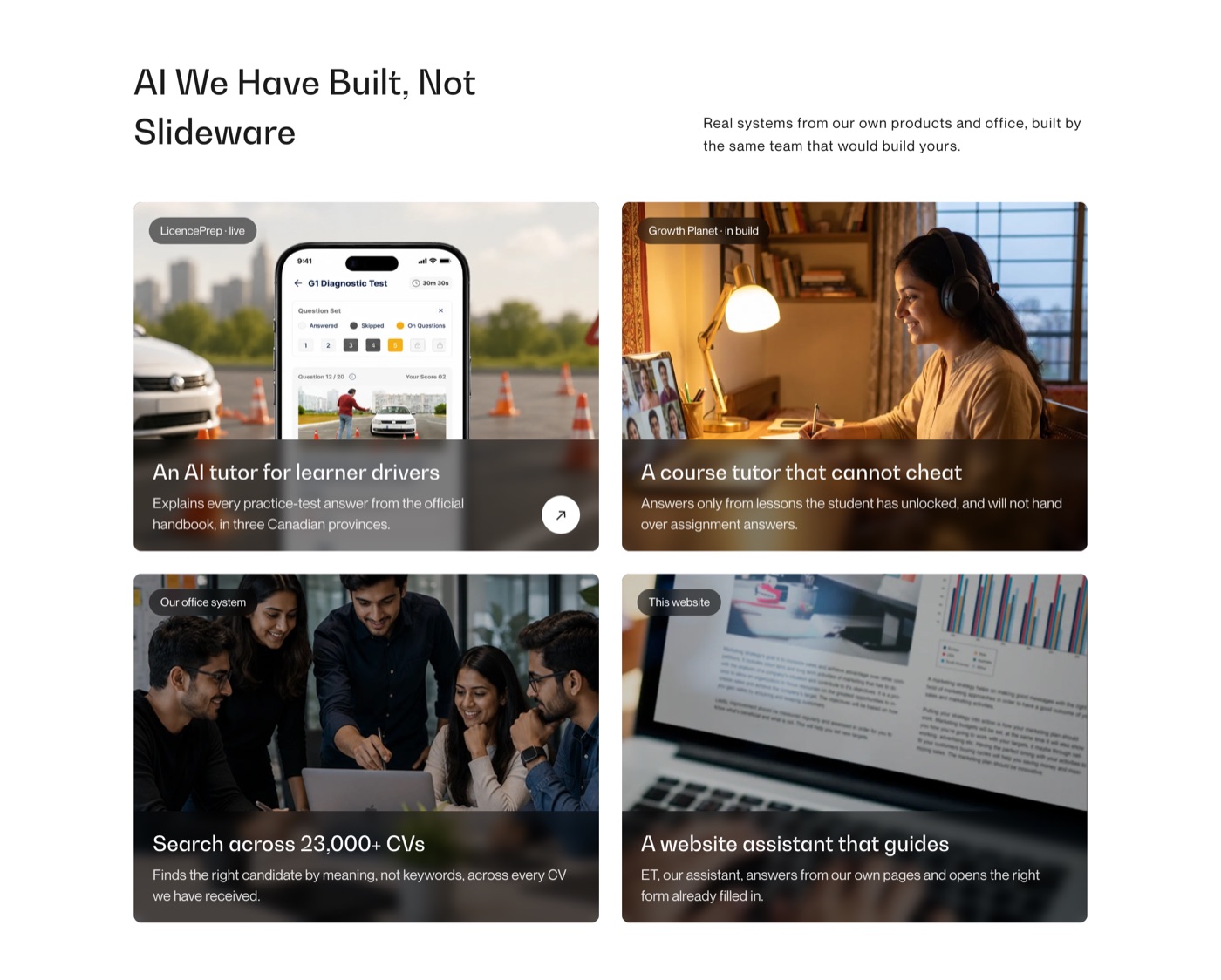
We have built this
AI we have built and run
Our office system searches more than 23,000 CVs by meaning, not keywords. LicencePrep’s tutor explains every answer from the official handbook. Growth Planet’s tutor answers only from the lessons a student has unlocked.
Want this for your business?
Ask ET on our website, or book a free 30-minute call with a project lead, not a salesperson.

