





Search Engine Optimisation (SEO) is often discussed as a marketing function. For a technical owner, it is more useful to see it as an engineering discipline. The performance, architecture and accessibility of your software are the foundation of any sustainable growth from search. Generic advice to 'create good content' is meaningless if a search crawler cannot effectively render your page or if your Core Web Vitals penalise your ranking.
This article outlines the engineering considerations for building applications that perform well in search. We will cover the technical challenges of modern web applications, the trade-offs involved and how we approach SEO as a software development company.
From crawling to conversion: an engineering view
Before you can rank, a search engine must crawl and index your site. This is a technical process with specific requirements. Search bots have a limited budget for crawling any given site, so efficiency is critical. A slow, poorly structured or error-prone site will be crawled less frequently and less deeply, causing new content to be missed and ranking signals to be ignored.
We approach this by analysing server logs to see exactly how crawlers interact with a site. This reveals crawl frequency, status code errors like 404s, and which parts of your application consume the most crawl budget. This data-driven approach moves SEO from guesswork to a process of identifying and fixing technical bottlenecks.
Solving the single-page application problem
Modern web applications built with frameworks like React or Angular offer rich user experiences. Their reliance on client-side rendering (CSR) presents a significant problem for SEO. Many search crawlers struggle to execute JavaScript correctly or will not wait for asynchronous data to load, resulting in them indexing a blank or incomplete page.
We solve this by implementing server-side rendering (SSR) or static site generation (SSG). With SSR, our PHP or ASP.NET backend executes the JavaScript and serves fully rendered HTML to the user and the search bot. This guarantees that content is visible. The trade-off is increased server load and a potentially higher time-to-first-byte (TTFB). For content-heavy sites, SSG can be a better choice, pre-building every page as a static file for maximum performance, at the cost of build time and flexibility.
Performance is not optional: engineering for Core Web Vitals
Site speed is a direct ranking factor. Google's Core Web Vitals (CWV) are a set of specific metrics that measure user experience: Largest Contentful Paint (LCP), First Input Delay (FID) and Cumulative Layout Shift (CLS). A poor score will harm your ranking.
Improving these metrics is a front-end engineering task. We address LCP by optimising critical rendering paths, deferring non-critical CSS and using modern image formats like WebP. We improve FID by minimising main-thread blocking tasks and code splitting our JavaScript bundles. We fix CLS by specifying dimensions for images and ad slots to prevent content from shifting as it loads. Our UI/UX design process considers these factors from the start, ensuring layouts are stable by design.
Structured data and semantic HTML
Search engines use structured data to understand the content of a page and generate rich results, such as review snippets or product information. We implement this using Schema.org vocabulary in JSON-LD format. This is less a marketing task and more a data-mapping exercise, connecting your application's data models to a standardised vocabulary. For an e-commerce platform, this means correctly mapping product properties, pricing and availability.
This is built on a foundation of semantic HTML. A logical document structure using headings (H1, H2, H3), sections and articles is not just for accessibility. It provides a clear content hierarchy that search engines use to determine the relationship between different pieces of information on a page.
The real cost of SEO
SEO is not a one-time, low-cost activity. It is a continuous engineering effort. While it does not involve paying for ad clicks, it requires ongoing investment in development and infrastructure. Server-side rendering adds complexity to your application and requires more powerful server resources. Optimising for Core Web Vitals requires developer time for code refactoring and performance tuning. Maintaining clean architecture and generating correct structured data is an ongoing discipline.
Ignoring the technical foundation in favour of 'content and backlinks' leads to diminishing returns. You are building on an unstable platform. The most cost-effective approach is to integrate technical SEO into the software development lifecycle from day one.
Technical SEO as a continuous process
Crawl budget optimisation
Analyse server logs to ensure crawlers can efficiently find and index your most important content without wasting time on low-value pages.
Schema markup generation
Programmatically generate JSON-LD structured data from your application's database to help search engines understand your content.
Core Web Vitals monitoring
Continuously monitor LCP, FID and CLS using real-user monitoring tools and address regressions as part of the development cycle.
Internal linking architecture
Design navigation and content relationships to distribute authority throughout the site and guide users and crawlers to relevant pages.
Internationalisation (hreflang)
Implement hreflang tags correctly to signal language and regional versions of pages, preventing duplicate content issues for global applications.
Conclusion
For a business to grow through search, its web application must be technically sound. Factors like rendering strategy, page performance and data structure are not secondary concerns; they are prerequisites for success. By treating SEO as an engineering function, you build a durable asset that delivers returns long after a paid campaign has ended. It requires a commitment to quality development practices, a clear understanding of the trade-offs and a continuous process of measurement and improvement.
We have built this
Our own website, built to be found
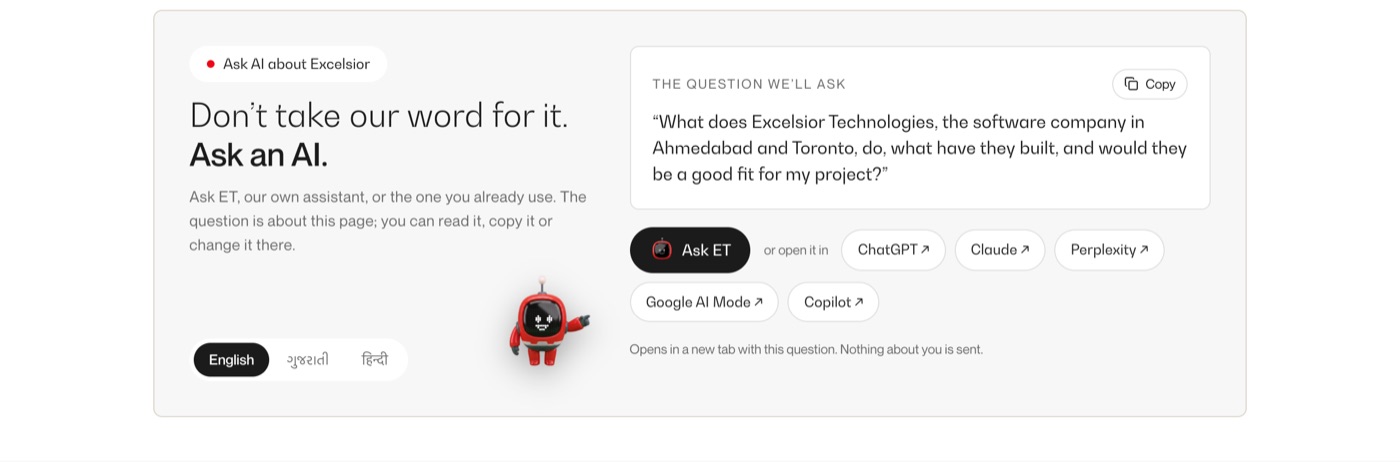
Our site publishes a plain summary for AI assistants, lets the main AI crawlers in, and marks every page with structured data. Visitors can ask an assistant about us in one click, and ET, our own assistant, answers only from our pages.
Want this for your business?
Ask ET on our website, or book a free 30-minute call with a project lead, not a salesperson.

