
In 30 seconds
- AI pays back first on tasks your team repeats every day: answering the same questions, sorting requests, drafting replies, pulling facts from documents.
- It pays back last on rare, high-stakes judgement calls, and on anything where a wrong answer cannot be caught before it reaches a customer.
- Start with one task, measure it for a few weeks, then decide on the next.
Most AI projects that disappoint were not bad technology. They were the wrong first task: too rare to matter, too vague to automate, or too risky to let a machine touch without a person checking.
The tasks that pay back first look boring. That is exactly why they work.
The tasks where AI pays back first
Six kinds of work turn up in almost every business. All six are frequent, follow rules, and are easy to check.
Answering the same questions
Opening hours, prices, delivery times, “do you do X?”. An assistant trained on your own pages answers at 2 a.m. and passes anything unusual to a person.
Sorting what comes in
Emails, WhatsApp messages and form submissions, read, tagged (sales, support, complaint, invoice) and sent to the right person.
Drafting replies
Your team edits and sends instead of writing from scratch.
Pulling facts from documents
Invoices, purchase orders, CVs, contracts: the fields extracted and filled into your system.
Summarising
A long thread or a call becomes five lines and a next step.
Spotting what is missing
An order without a GST number, a form without a signature: flagged before it slows someone down.
The four-question test
Before you pick, run each candidate task through four questions. Here they are, applied to two real tasks.
How it works
The four-question test for your first AI task
The steps, in words
- Does it happen every day?: Frequent tasks pay back fastest. Once a quarter is not worth automating yet.
- Does it follow rules you could write down?: If two of your staff would handle it the same way, AI can learn the pattern.
- Is it mostly reading and writing?: Emails, forms, documents, chats: this is where today’s AI is strongest.
- Can a person check the result quickly? (a person decides): A two-second check keeps quality high while you build trust.
A task that passes all four is a strong first project. One that fails two or more is better left with a person for now, or prepared by AI and decided by a person.
Where AI does not pay back yet
Hand it to AI
- Work that repeats every day
- Rules you could write down
- Mostly reading and writing
- A result a person can check in seconds
Keep it with a person, for now
- Rare decisions with big consequences: a large discount, a legal position, a hire
- Tasks nobody can describe (“I just know”)
- Anything a customer sees before anyone checks it
- Tiny volumes: ten requests a month are cheaper by hand
The right-hand column is not “never”. For a rare, high-stakes call, AI can still gather the facts and draft the options while a person decides. For a task nobody can describe, write down how your best person decides first. Then automate.
In practice
A distributor’s order inbox
Say a distributor gets “where is my order?” questions all day, by email and WhatsApp. Run the test:
- Every day? Yes, many times a day.
- Rules you could write down? Yes: find the order, read its status, reply.
- Mostly reading and writing? Yes: a message in, a short reply out.
- Can a person check it quickly? Yes: a glance at the draft before pressing send.
It passes all four. The first version drafts each reply from the order system and a person sends it. Once the drafts stop needing edits, the simple cases go out on their own and the team handles only the unusual ones.
How to measure it
Pick one number before you start, and check it every week.
A sensible first month
- Week 1Pick and collect
Choose the task with the four-question test, and collect 50 real examples.
- Week 2Suggest, don’t act
A small version suggests; a person approves every result.
- Weeks 3–4Measure
If it is right almost every time, let it act alone on the simple cases.
- Month 2The next task
Keep the first one running, and test the next candidate.
We have built this
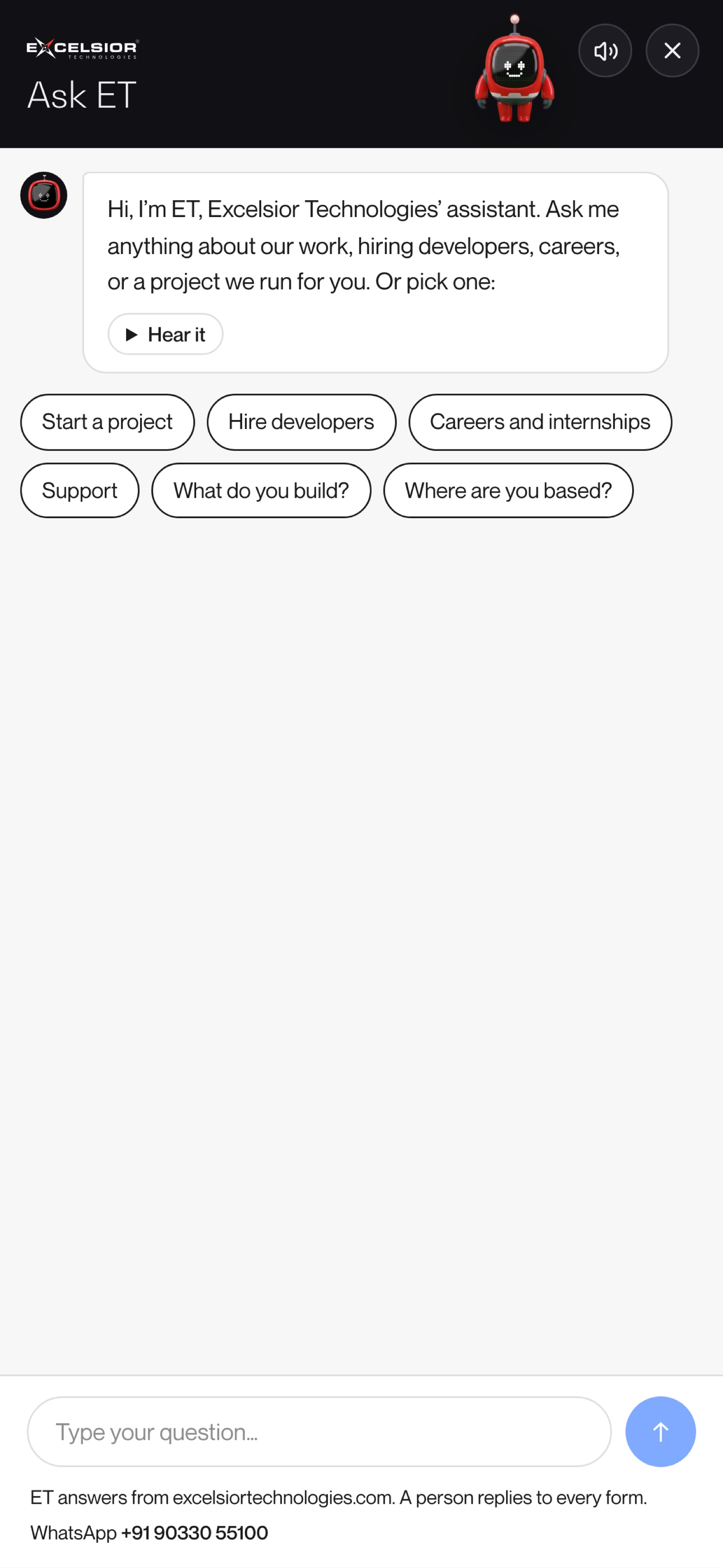
ET, the assistant on our own website
We chose a task that passes all four questions: answering the same visitor questions about our services, work and hiring, every day.
ET answers only from our own pages, and when a visitor wants to hire or start a project, he opens the right form with their answers already filled in. A person replies to every form.
The pattern is the same whether you are a clinic, a distributor or a training institute: one task, a person checking, a number to watch. Get the first one right, and the second and third get faster and cheaper.
Frequently asked questions
How much does a first AI project cost?
It depends on the task and your systems. A focused first project, one task with a person approving, is usually a small build compared with an app or website. Our free AI readiness check gives you a range for your case.
Do we need to share all our data with an AI company?
No. A first project needs only the documents or messages for that one task, and it can run inside your own cloud account so your data stays under your control.
Will this replace staff?
In most small businesses it removes the repetitive part of a job, so people spend their time on customers and decisions. Start with the work your team likes least.
What if the AI gets something wrong?
That is why the first version suggests and a person approves. You only let it act alone on the simple cases once you have seen it be right, week after week.
Want this for your business?
Ask ET on our website, or book a free 30-minute call with a project lead, not a salesperson.