





This article originally explored the reasons for WordPress's popularity when its primary use was for blogging and simple content sites. The arguments focused on its low cost, ease of use for non-technical users and search engine friendliness. Years later, the platform has evolved. We are revisiting those points to assess what has changed and where WordPress fits in a modern development stack.
At the time, the appeal was clear. WordPress offered a way for users to manage their own content without FTP access or HTML knowledge. It was open source, making it free to download, and a vast community supplied themes and plugins. For many, this was a sufficient solution. But the web has grown more complex, and so has WordPress.
From content manager to application framework
The core value proposition of WordPress is no longer just simple content management. The introduction of the REST API transformed it into a headless CMS, capable of serving content to separate frontend applications built with frameworks like React or Angular. The Gutenberg block editor, once a controversial change, has matured into a powerful tool for building structured, component-based page layouts.
This shift means WordPress is now a viable foundation for more than just websites. It can act as the backend for mobile apps, e-commerce platforms and complex membership sites. Its familiarity for content editors remains a significant advantage, but its technical capabilities have expanded considerably.
The original arguments reconsidered
Cost effectiveness
WordPress itself is free, but a professional implementation is not. The total cost of ownership includes custom development, managed hosting, security monitoring and ongoing maintenance. Relying on a patchwork of third-party plugins can also introduce licensing fees and long-term support costs.
Simplicity of use
For content creators and site administrators, the interface remains relatively straightforward. For developers, building a custom, performant and secure WordPress site requires deep knowledge of PHP, the WordPress hook and filter system, database optimisation and JavaScript for the block editor or a decoupled frontend.
The plugin ecosystem
The repository of plugins provides ready-made functionality that can accelerate development. However, it is also the platform's largest liability. Each plugin adds a potential attack surface, can create performance bottlenecks and may cause conflicts or break during major updates. Vetting plugins for code quality and support is critical.
Search engine friendliness
WordPress provides the tools for good technical SEO, but it does not guarantee results. Achieving high rankings still depends on content quality, site structure, performance and a coherent strategy. A default installation requires significant configuration and optimisation to perform well in search engines.
The trade-offs in modern WordPress development
Choosing WordPress means accepting a specific set of technical trade-offs. Its history as a blogging platform means it carries legacy code and architectural decisions that can be cumbersome. Performance requires constant attention, with disciplined approaches to image optimisation, caching strategies and database queries.
Security is a persistent concern due to its popularity as a target. A production WordPress site requires a rigorous security posture, including regular updates, user role management, a web application firewall and the removal of all unused themes and plugins. Automatic updates are useful, but they are not a substitute for a proper staging and deployment workflow to test for breaking changes.
Our approach to WordPress
We treat WordPress as a development framework. We use it when a project's primary need is a flexible and user-friendly content management experience. Our work focuses on custom theme and plugin development using modern PHP and JavaScript practices, rather than assembling sites from pre-built components. We build custom web applications for clients, and for projects requiring a mature CMS, WordPress is one of the frameworks we use. This approach allows us to deliver sites that are tailored to specific business needs while providing a familiar editing environment for your team.
We have built this
Our own website, built to be found
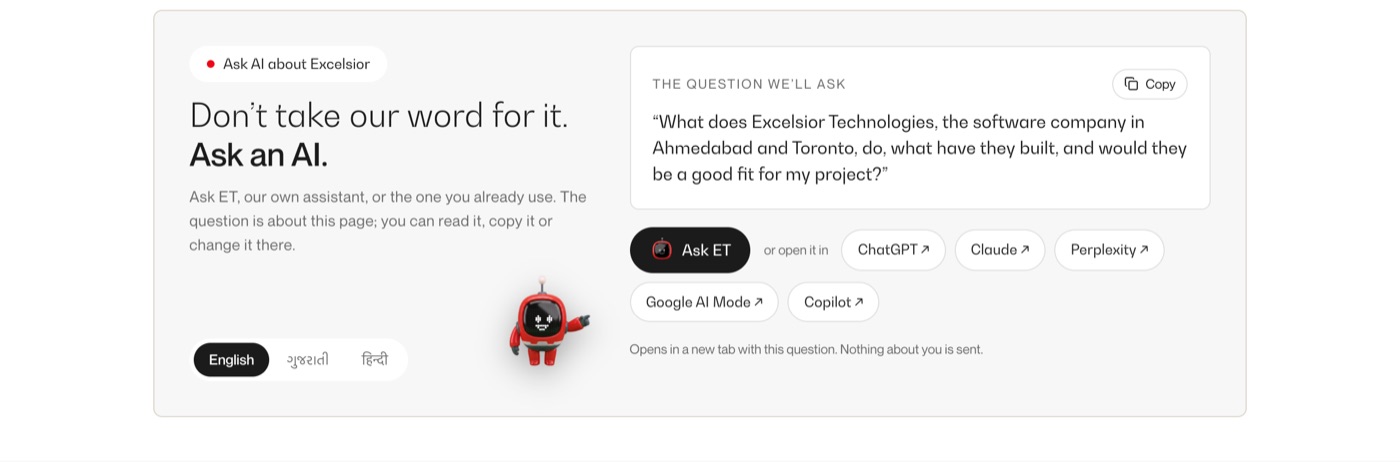
Our site publishes a plain summary for AI assistants, lets the main AI crawlers in, and marks every page with structured data. Visitors can ask an assistant about us in one click, and ET, our own assistant, answers only from our pages.
Want this for your business?
Ask ET on our website, or book a free 30-minute call with a project lead, not a salesperson.

